Heterodox
economics refers to economic theories and
communities of economists that are in various ways
an alternative to mainstream economics. It is a
multi-level term that refers to a body of economic
theories developed by economists who hold an
irreverent position vis-à-vis mainstream economics
and are typically rejected out of hand by the
latter; to a community of heterodox economists whom
identify themselves as such and embrace a
pluralistic attitude towards heterodox theories
without rejecting contestability and
incommensurability among heterodox theories; and to
the development of a coherent economic theory that
draws upon various theoretical contributions by
heterodox approaches which stand in contrast to
mainstream theory. Thus, this introduction to
heterodox economics is organized as follows: the
first section outlines the emergence of “heterodox
economics” in the sense of a body of heterodox
theories; the second deals with heterodox economics
as a pluralist community of heterodox economists;
the third section situates heterodox economics
relative to mainstream economics; and the fourth
section delineates heterodox economics in terms of
theory and policy.
Heterodox
Economics as a Group of Heterodox Theories
Heterodox as an identifier of an economic theory
and/or economist that stands in some form of dissent
relative to mainstream economics was used within the
Institutionalist literature from the 1930s to the
1980s. Then in 1987, Allan Gruchy used heterodox
economics to identify Institutional as well as
Marxian and Post Keynesian theories as ones that
stood in contrast to mainstream theory. By the
1990s, it became obvious that there were a number of
theoretical approaches that stood, to some degree,
in opposition to mainstream theory. These heterodox
approaches included Austrian economics, feminist
economics, Institutional-evolutionary economics,
Marxian-radical economics, Post Keynesian and
Sraffian economics, and social economics; however,
it was not possible to use any of the names of the
various heterodox approaches to represent them
collectively. Thus, terms, such as non-traditional,
non-orthodox, non-neoclassical, non-mainstream, were
used to collectively represent them, but they did
not have the right intellectual feel or a positive
ring. Moreover, some thought that political economy
(or heterodox political economy) could be used as
the collective term, but its history of being
another name for Marxian-radical economics (and its
current reference to public choice theory) made this
untenable. Therefore, to capture the commonality of
the various theoretical approaches in a positive
light without prejudicially favoring any one
approach, a descriptive term that had a pluralist
‘big-tent feel’ combined with being unattached to a
particular approach was needed. Hence, ‘heterodox’
became increasingly used throughout the 1990s in
contexts where it implicitly and/or explicitly
referred to a collective of alternative theories
vis-à-vis mainstream theory and to the economists
that engaged with those theories.
The final stage in the general acceptance of
heterodox economics as the ‘official’ collective
term for the various heterodox theories began circa
1999. First there was the publication of Phillip
O’Hara’s comprehensive Encyclopedia of Political
Economy (1999), which explicitly brought together
the various heterodox approaches.
At the same time, in October 1998 Fred Lee
established the Association for Heterodox Economics
(AHE); and to publicize the conference and other
activities of the AHE as well as heterodox
activities around the world, he also developed from
1999 to the present an informal ‘newsletter’ that
eventually became (in September 2004) the Heterodox
Economics Newsletter, now received by over 3200
economists worldwide (see
http://www.heterodoxnews.com ). These twin
developments served to establish heterodox economics
as the preferred terminology by which these groups
of economists referred to themselves.
Heterodox Economics as a Community of
Heterodox Economists
Heterodox economics also denotes a community of
heterodox economists, which implies that the members
are not segregated along professional and
theoretical lines. With regard to the segregation of
professional engagement, except for two instances in
the mid-1970s, it has not existed among heterodox
associations. For example, from their formation in
1965 - 1970, the three principal heterodox
associations in the United States, AFEE, ASE, and
URPE, opened their conferences to Institutionalist,
social economics, radical-Marxian, and Post
Keynesian papers and sessions; appointed and/or
elected heterodox economists to the editorial boards
of their journals and to their governing bodies who
also were members of other heterodox associations or
engaged with Post Keynesian economics; and had
members who held memberships in other heterodox
associations, engaged with Post Keynesian economics,
and subscribed to more than one heterodox economics
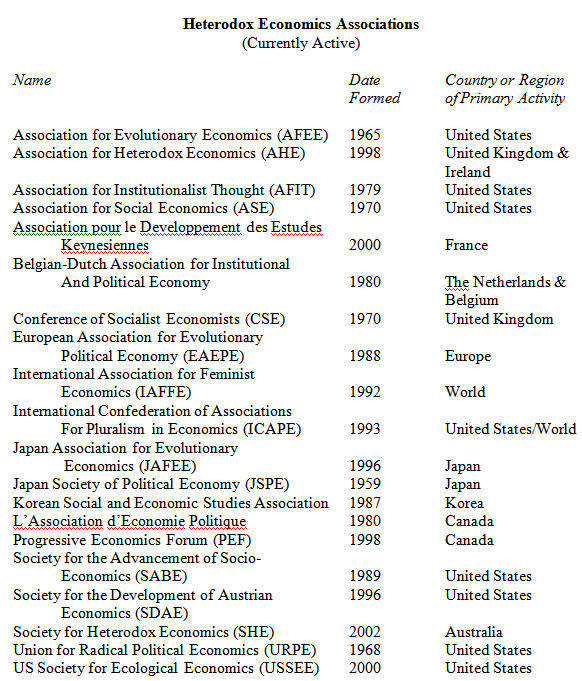
journal. Moreover, a number of heterodox
associations formed since 1988, such as AHE, EAEPE,
ICAPE, SDAE, and SHE, have adopted an explicitly
pluralistic approach towards their name, membership,
and conference participation—for a list of heterodox
associations, dates formed, and primary country or
region of activity, see Table 1. Finally, the
informal and explicit editorial policies of
heterodox journals have, from their formation,
accepted papers for publication that engage with the
full range of heterodox approaches; and this
tendency has strengthen since the mid-1990s as
heterodox economics became more accepted. To
illustrate, from 1993 to 2003 the eight principal
English language generalist heterodox
journals--Cambridge Journal of Economics, Capital
and Class, Feminist Economics, Journal of Economic
Issues, Journal of Post Keynesian Economics, Review
of Political Economy, Review of Radical Political
Economics, and Review of Social Economy--cited each
other so extensively that no single journal or
sub-set of journals was/were isolated; hence they
form an interdependent body of literature where all
heterodox approaches have direct and indirect
connections with each other. Thus, in terms of
professional engagement over the last ten years, the
heterodox community is a pluralistic integrative
whole.
Table 1
Theoretical segregation involves the isolation of a
particular theoretical approach and its adherents
from all other approaches and their adherents; that
is to say, theoretical segregation occurs when there
is no engagement across different theoretical
approaches. However it does not exist within
heterodox economics currently and nor has it existed
in the past among the various heterodox approaches.
From the 1960s through the 1980s heterodox
economists engaged, integrated or synthesized
Institutional, Post Keynesian, and Marxist-radical
approaches, Institutional and Post Keynesian
approaches, Post Keynesian and Marxian-radical
approaches, Post Keynesian and Austrian, Austrian
and Institutionalists, Feminist and Marxist-radical
approaches, Institutional and Marxist-Radical
Approaches, Institutional and Social Economics,
ecological and Marxian-radical approaches, and
social and Marxian economics. Thus by 1990 many
heterodox economists could no longer see distinct
boundaries between the various approaches. Moreover,
heterodox economics in the 1990s to the present day
continued the past integration efforts of engaging
across the various heterodox approaches. Hence, it
is clear that the heterodox community is not
segregated along theoretical lines, but rather there
is cross-approach engagement to such an extent that
the boundaries of the various approaches do not
simply overlap, they are, in some cases, not there
at all. The ensuing theoretical messiness of
cross-approach engagement is evidence to detractors
of the theoretical incoherence of heterodox
economics whereas to supporters of progress towards
a more theoretically coherent heterodox economics—a
glass half-empty of coherence vs. a glass half-full
of coherence.
Heterodox Critique of Mainstream
Economics
Mainstream economics is a clearly defined
theoretical story about how the economy works; but
this story is theoretically incoherent. That is,
mainstream theory is comprised of a core set of
propositions—such as scarcity, equilibrium,
rationality, preferences, and methodological
individualism and derivative beliefs, vocabulary,
symbols and parables, while there is a range of
heterogeneous theoretical developments beyond the
core that do not call into question the core itself
in totality. As a result, critiques of the theory
vary in that they can deal with the internal
coherence and/or empirical grounding of the theory,
can be directed at the theory at a particular point
in time or at specific components of theory (such as
methodology, concepts qua vocabulary, parables qua
stories, and symbols), and can be initiated from a
particular heterodox approach. What emerges is a
varied but concatenate of particular and extensive
critiques that generate an emergent encompassing
rejection of mainstream theory, although any one
particular critique may not go that far.
Although the internal and story qua model critiques
show that the theory is incoherent, they do not by
themselves differentiate mainstream from heterodox
theory. This, however, can be dealt with in terms of
specific critiques of the core propositions. That
is, each of the heterodox approaches has produced
critiques of particular core propositions of the
theory, while each core proposition has been subject
to more than one critique; in addition, the multiple
heterodox critiques of a single proposition overlap
in argumentation. To illustrate, consider the
critiques of the concept of scarcity. The Post
Keynesians argue that produced means of production
within a circular production process cannot be
characterized as scarce and that production is a
social process; while Institutionalists reject the
view that natural resources are not ‘produced’ or
socially created to enter into the production
process; and the Marxists argue that the concept is
a mystification and misspecification of the economic
problem—that it is not the relation of the isolated
individual to given resources, but the social
relationships that underpin the social provisioning
process. The three critiques are complementary and
integrative and generate the common conclusion that
the concept of scarcity must be rejected as well as
the mainstream definition of economics as the
science of the non-social provisioning process
analyzed through the allocation of scarce resources
among competing ends given unlimited asocial wants
of asocial individuals. Other critiques of the core
propositions exist and arrive at similar
conclusions. Together the three critiques—internal,
story qua model, and core propositions—form a
concatenated structured heterodox critique that
rejects and denies the truth and value of mainstream
theory.
Heterodox Economics: Theory and
Policy
Since the intellectual roots of heterodox economics
are located in traditions that emphasize the wealth
of nations, accumulation, justice, social
relationships in terms of class, gender, and race,
full employment, and economic and social
reproduction, the discipline of economics, from its
perspective, is concerned, not with prediction per
se, but with explaining the actual process that
provides the flow of goods and services required by
society to meet the needs of those who participate
in its activities. That is, economics is the science
of the social provisioning process, and this is the
general research agenda of heterodox economists. The
explanation involves human agency in a cultural
context and social processes in historical time
affecting resources, consumption patterns,
production and reproduction, and the meaning (or
ideology) of market, state, and non-market/state
activities engaged in social provisioning. Thus
heterodox economics has two interdependent parts:
theory and policy. Heterodox economic theory is an
empirically grounded theoretical explanation of the
historical process of social provisioning within the
context of a capitalist economy. Therefore it is
concerned with explaining those factors that are
part of the process of social provisioning,
including the structure and use of resources, the
structure and change of social wants, structure of
production and the reproduction of the business
enterprise, family, state, and other relevant
institutions and organizations, and distribution. In
addition, heterodox economists extend their theory
to examining issues associated with the process of
social provisioning, such as racism, gender, and
ideologies and myths. Because their economics
involves issues of ethical values and social
philosophy and the historical aspects of human
existence, heterodox economists make ethically-based
economic policy recommendations to improve human
dignity, that is, recommending ameliorative and/or
radical, social, and economic policies to improve
the social provisioning and hence well-being for all
members of society and especially the disadvantage
members. To do this right, their economic policy
recommendations must be connected to heterodox
theory which provides an accurate historical and
theoretical picture of how the economy actually
works—a picture that includes class and hierarchical
domination, inequalities, and social-economic
discontent.
Given the definition of economics as the science of
the social provisioning process and the structure of
the explanation of the process combined with the
pluralistic and integrative proclivities of
heterodox economists, there has emerged a number of
elements that have come to constitute the
provisional theoretical and methodological core of
heterodox theory. Some elements are clearly
associated with particular heterodox approaches as
noted by O’Hara:
The main thing that social economists bring to the
study [of heterodox economics] is an emphasis on
ethics, morals and justice situated in an
institutional setting. Institutionalists bring a
pragmatic approach with a series of concepts of
change and normative theory of progress, along with
a commitment to policy. Marxists bring a set of
theories of class and the economic surplus.
Feminists bring a holistic account of the ongoing
relationships between gender, class, and ethnicity
in a context of difference….And post-Keynesians
contribute through an analysis of institutions set
in real time, with the emphasis on effective demand,
uncertainty and a monetary theory of production
linked closely with policy recommendations. [O’Hara,
2002, p. 611]
However, other provisional elements, such as
critical realism, non-equilibrium or historical
modeling, the gendering and emotionalizing agency,
the socially embedded economy, and circular and
cumulative change, emerged from a synthesis of
arguments that are associated only in part with
particular heterodox approaches.
The core methodological elements establish the basis
for constructing heterodox theory. In particular,
the methodology emphasizes realism, structure,
feminist and uncertain agency qua individual,
history, and empirical groundness in the
construction of heterodox theory, which is a
historical narrative of how capitalism works. The
theory qua historical narrative does not simply
recount or superficially describe actual economic
events, such as the exploitation of workers; it does
more in that it analytically explains the internal
workings of the historical economic process that,
say, generate the exploitation of workers. Moreover,
because of its historical nature, the narrative is
not necessarily organized around the concepts of
equilibrium/long period positions and tendencies
towards them. Because the narrative provides an
accurate picture of how capitalism actually works
and changes in a circular and cumulative fashion,
economists use their theory to suggest alternative
paths future economic events might take and propose
relevant economic policies to take them. In
constructing the narrative, they have at the same
time created a particular social-economic-political
picture of capitalism.
The core theoretical elements generate a
three-component structure-organization-agency
economic theory. The first component of the theory
consists of three overlapping interdependencies that
delineate the structure of a real capitalist
economy. The first interdependency is the production
of goods and services requires goods and services to
be used as inputs. Hence, with regard to production,
the overall economy (which includes both market and
non-market production) is represented as an
input-output matrix of material goods combined with
different types of labor skills to produce an array
of goods and services as outputs. Many of the
outputs replace the goods and services used up in
production and the rest constitute a physical
surplus to be used for social provisioning, that is
for consumption, private investment, government
usage, and exports. A second interdependency is the
relation between the wages of workers, profits of
enterprises, and taxes of government and
expenditures on consumption, investment, and
government goods as well as non-market social
provisioning activities. The last interdependency
consists of the overlay of the flow of funds or
money accompanying the production and exchange of
the goods and services. Together these three
interdependencies produce a monetary input-output
structure of the economy where transactions in each
market are a monetary transaction; where a change in
price of a good or the method by which a good is
produced in any one market will have an indirect or
direct impact on the entire economy; and where the
amount of private investment, government expenditure
on real goods and services, and the excess of
exports over imports determines the amount of market
and non-market economic activity, the level of
market employment and non-market laboring
activities, and consumer expenditures on market and
non-market goods and services. These elements of
course have parallels in non-heterodox economics,
but the ideas are developed in ways that are
different.
The second component of heterodox theory consists of
three broad categories of economic organization that
are embedded in the monetary input-output structure
of the economy. The first category is micro
market-oriented, hence particular to a set of
markets and products. It consists of the business
enterprise, private and public market organizations
that regulate competition in product and service
markets, and the organizations and institutions that
regulate the wages of workers. The second is macro
market-oriented and hence is spread across markets
and products, or is not particular to any market or
product. It includes the state and various
subsidiary organizations as well as particular
financial organizations, that is those organizations
that make decisions about government expenditures
and taxation, and the interest rate. Finally the
third category consists of non-market organizations
that promote social reproduction and include the
family and state and private organizations that
contribute to and support the family. The
significance of organizations is that they are the
social embeddedness of agency qua the individual,
the third component of heterodox theory. That is,
agency, which are decisions made by individuals
concerning the social provisioning process and
social well-being, takes place through these
organizations. And because the organizations are
embedded in both instrumental and ceremonial
institutions, such as gender, class, ethnicity,
justice, marriage, ideology, and hierarchy qua
authority, agency qua the individual acting through
organizations affect both positively and negatively
but never optimally the social provisioning process.
Conclusion
If mainstream economics suddenly disappeared,
heterodox economics would be largely unaffected. It
would still include the various heterodox
traditions; there would still be a integrated
professional and theoretical community of heterodox
economists; and its heterodox research agenda would
still be directed at explaining the social
provisioning process in capitalist economies and
argue for economic policies that would enhance
social well-being. In this regard, heterodox
economics is not out to reform mainstream economics.
Rather it is an alternative to mainstream economics:
an alternative in terms of explaining the social
provisioning process and suggesting economic
policies to promote social well-being. Over the past
decade the community of heterodox economics has
grown, diversified, and integrated. The previously
isolated are now part of a community; heterodox
associations exist in countries where previously no
heterodox associations had existed; and developments
in heterodox theory and policy are occurring at
breakneck speed. In short, heterodox economics is
now an established feature on the disciplinary
landscape and the progressive future of economics.
Bibliography
Bortis, H. 1997. Institutions, Behaviour and
Economic Theory. Cambridge: Cambridge University
Press.
Dow, S. C. 2000. “Prospects for the Progress of
Heterodox Economics.” Journal of the History of
Economic Thought 22.2 (June): 157 – 170.
Granovetter, M. 1985. "Economic Action and Social
Structure: The Problem of Embeddedness," American
Journal of Sociology 91 (November): 481 - 510.
Gruchy, A. G. 1987. The Reconstruction of Economics:
An Analysis of the Fundamentals of Institutional
Economics. New York: Greenwood Press.
Keen, S. 2001. Debunking Economics: The Naked
Emperor of the Social Sciences. New York City: St.
Martin’s Press.
Lavoie, M. 2006. “Do Heterodox Theories Have
Anything in Common? A Post-Keynesian Point of View.”
Intervention: Journal of Economics 3.1: 87 – 112.
Lawson, T. 1997. Economics and Reality. London:
Routledge.
Lee, F. S. 2001. “Conference of Socialist Economists
and the Emergence of Heterodox Economics in Post-War
Britain.” Capital and Class 75 (Autumn): 15 – 39.
Lee, F. S. 2002. “The Association for Heterodox
Economics: Past, Present, and Future.” Journal of
Australian Political Economy 50 (December): 29 – 43.
Lee, F. S. 2004. “To be a Heterodox Economist: The
Contested Landscape of American Economics, 1960s and
1970s.” Journal of Economic Issues 38.3 (September):
747 – 763.
Lee, F. S. and Keen, S. 2004. “The Incoherent
Emperor: A Heterodox Critique of Neoclassical
Microeconomic Theory.” Review of Social Economics
62.2 (June): 169 – 199.
Matthaei, J. 1984. “Rethinking Scarcity:
Neoclassicism, NeoMalthusianism, and NeoMarxism.”
Review of Radical Political Economics 16.2/3
(Summer-Fall): 81 – 94.
O’Hara, P. A. (ed.) 1999. Encyclopedia of Political
Economy. London: Routledge.
O’Hara, P. A. 2000. Marx, Veblen, and Contemporary
Institutional Political Economy:
Principles and Unstable Dynamics of Capitalism.
Cheltenham: Edward Elgar.
O’Hara, P. A. 2002. “The Role of Institutions and
the Current Crises of Capitalism: A
Reply to Howard Sherman and John Henry.” Review of
Social Economy 60.4 (December): 609 – 618.
Power, M. 2004. “Social Provisioning as a Starting
Point for Feminist Economics.”
Feminist Economics 10.3 (November): 3 – 19.
White, G. 2004. “Capital, Distribution and
Macroeconomics: ‘Core’ Beliefs and
Theoretical Foundations.” Cambridge Journal of
Economics 28.4 (July): 527 – 547.
Wrenn, M. V. 2004. “What is Heterodox Economics?”
Ph.D. diss. Colorado State University.
